
About
Independent perspective for decisions that carry weight.
We help leaders understand exposure, identify relevant emerging threats, and prioritize what matters most.
Our Mission
Purple Intelligence exists to give leaders of consequential missions the independent, outside-in perspective they cannot generate from within. We correlate open, lawful signals into a single decision-oriented read—so organizations can anticipate emerging threats, reduce exposure, and protect the people, programs, and continuity that matter most.
See what others can see—before it becomes leverage.
One discipline, two directions
Protection today. Competition next.
Outside-in analysis is one discipline applied in two directions. Today we lead with the first; the second is where the same method points next.
Protection Mode
We turn the outside-in lens onto your own mission—surfacing what an adversary could observe, infer, and exploit—so you can reduce exposure and protect people, programs, and continuity.
Competition Mode
The same lawful, ethics-bound method pointed outward—reading the public signature of competitors and market rivals to inform strategy. Always within legal and ethical limits; never intrusion, never misrepresentation.
Why outside-in
You cannot grade your own external signature from the inside.
Internal teams have blind spots. The assumptions that make you effective on the inside are the same ones that hide what an informed outsider can infer. We exist to provide the required independent, outside view—and to convert ordinary public signals into operational clarity.
Principles
What we hold to.
Mission first
Every finding is framed against the mission and the decisions leadership owns.
Evidence over assumptions
We separate what is observed from what is inferred, assumed, or imagined.
Perspective, not fear
We provide clarity and prioritization, never fear-based pressure.
Vendor neutrality
We do not sell the hardware or services we may recommend you evaluate.
Quality over quantity
We deliver a small number of decisions that matter, not an exhaustive risk list.
The Purple Score
A baseline measure of mission exposure and readiness.
The Purple Score gives leadership a single, trackable reference for how exposed the mission is and how ready it is to respond. It is a decision-support tool for tracking priorities over time—deliberately, not a scientific prediction that an incident will occur.
- A baseline you can track as exposure and readiness change
- A way to compare priorities and focus attention
- A shared reference for leadership conversations
- A probability that any specific incident will happen
- A published formula or scoring algorithm
- A substitute for validated, mission-specific judgment
Leadership
The people behind the work.
Names, credentials, and background details are added only once verified. Placeholders below mark where confirmed profiles will appear.
Leadership placeholder
Placeholder for a profile focused on analytical and targeting experience. Credentials are added only when verified.
Leadership placeholder
Placeholder for a profile focused on intelligence analysis and tradecraft. Background details are verified before publication.
Leadership placeholder
Placeholder for a profile focused on mission scoping and client engagement. Role scope is confirmed before any public claim.
FAQ
Questions leaders ask us.
A plain-language look at what we do, where our boundaries are, and how outside-in intelligence fits alongside the teams you already have.
What is Purple Intelligence?
Purple Intelligence provides independent, outside-in intelligence for organizations that need to understand what others can observe, infer, or potentially exploit about their mission. We use publicly available and authorized information, structured analysis, and mission context to identify apparent critical capabilities, exposures, emerging threats, and dependencies—then translate those findings into prioritized decisions. Our goal is simple: show you what matters, why it matters, and what you can do about it.
Why not just use AI?
We use AI where it improves speed and efficiency—but AI is a tool, not an independent intelligence function. AI can rapidly search, organize, summarize, and analyze information. The harder problem is determining what information matters to your specific mission, what deserves further collection, what conclusions the evidence actually supports, and what action should follow. Purple Intelligence provides the analytical framework around the technology: we define the intelligence problem, establish mission context, direct collection, evaluate competing explanations, distinguish facts from judgments and assumptions, assess confidence and limitations, and translate findings into decision-relevant recommendations. Put simply: AI can help process information; Purple Intelligence determines what matters, why, and how someone could use it against your organization and mission.
Couldn't our internal team do this?
Possibly—and Purple Intelligence is designed to complement, not replace, capable internal teams. The challenge is perspective. Internal teams naturally possess information, assumptions, processes, and institutional knowledge that an outsider does not. Those are strengths, but they can also influence how the organization evaluates itself. We deliberately begin from the outside—you can't completely grade your own homework. Our role is to provide an independent perspective that can validate internal assumptions, challenge them, or identify exposures that may be difficult to recognize from inside the organization.
Is Purple Intelligence just OSINT?
No. Publicly available information is an important input, but collecting information is not the final product. Purple Intelligence connects observable information to mission, critical capabilities, dependencies, threats, vulnerabilities, consequences, and decisions. The value isn’t simply finding information—it is determining what seemingly disconnected information means when viewed together, and what an organization should do about it.
What can someone actually learn about our organization from public information?
Often more than organizations expect. Hiring activity, employee profiles, facility information, permits, contracts, supplier relationships, conference presentations, leadership statements, logistics patterns, imagery, social media, procurement activity, and other observable signals can collectively reveal aspects of an organization's capabilities and dependencies. One piece of information may mean very little; several pieces viewed together can create a much clearer picture. Purple Intelligence evaluates that cumulative exposure.
Are you conducting penetration testing or attempting to access our systems?
No. Purple Intelligence operates within clearly defined legal and ethical boundaries. Our outside-in assessments use lawful publicly available information and other sources specifically authorized for the engagement. We do not need to compromise systems to demonstrate what an external observer may be able to learn.
How is this different from cybersecurity?
Cybersecurity primarily focuses on protecting information systems, networks, applications, identities, and data. Purple Intelligence examines the broader organizational picture—people, facilities, suppliers, operations, public information, physical exposure, emerging technologies, reputation, dependencies, and other factors that could affect the mission. Cybersecurity may therefore be one part of the picture, but not the entire picture.
How is this different from traditional risk management?
Traditional risk management often begins with what the organization already knows about itself. Purple Intelligence intentionally begins from another direction: What can an external observer see? What could they infer? What appears important? What could threaten it? Those findings can then strengthen existing risk management, mission assurance, security, continuity, and executive decision-making processes.
Do you sell security systems, counter-drone equipment, or other technology?
No. Purple Intelligence is vendor-neutral. We do not need to sell a particular security product for our assessment to create value. This allows us to focus on identifying and prioritizing the problem before recommending that an organization invest in a solution. Understand the problem first; buy technology second.
What is a Drone Exposure & Readiness Review?
Our Drone Exposure & Readiness Review examines an organization from the perspective of emerging unmanned aircraft threats. Rather than immediately recommending counter-UAS technology, we first ask: What matters at this location? How could drones affect it? What can be observed externally? Where are the likely exposure pathways? How prepared is the organization to recognize, report, respond to, and mitigate those risks? The result is a prioritized understanding of the organization’s drone risk and readiness—not a hardware sales pitch.
Do you provide counter-UAS services?
Purple Intelligence focuses on the intelligence and assessment layer of the counter-UAS problem. We can help organizations understand their threat environment, exposure, mission consequences, preparedness, and priorities before they make decisions about policies, training, procedures, technology, or specialized counter-UAS capabilities. Where specialized technical expertise or equipment is required, our analysis can help organizations ask better questions of those providers.
What do we actually receive from an assessment?
Depending on the engagement, deliverables may include an executive intelligence brief, external exposure profile, apparent mission-critical asset analysis, threat and emerging-threat outlook, prioritized vulnerabilities or dependencies, quick-win recommendations, and a decision roadmap. The objective is not to hand leadership a large collection of raw information—it is to provide prioritized decision support.
How do you distinguish facts from speculation?
Purple Intelligence explicitly separates: Fact—what the evidence directly supports; Judgment—what we assess the evidence likely means; Assumption—what must be true for an assessment to hold; and Scenario—what could plausibly occur if certain conditions develop. We also communicate confidence, alternative explanations, and important information gaps where appropriate. We would rather clearly state uncertainty than disguise it.
Can you tell us exactly what will happen?
No—and neither can anyone else. Intelligence reduces uncertainty; it does not eliminate it. Our purpose is to help leaders recognize relevant signals, understand plausible threats and consequences, identify information gaps, and make better decisions before uncertainty becomes a crisis.
Is this a one-time assessment?
It can be, but risk environments change. Organizations change. Personnel change. Technology changes. Public information changes. Threat actors adapt. New vulnerabilities emerge. Purple Intelligence can therefore support both rapid assessments and persistent decision advantage, including periodic outside-in reviews and emerging-threat updates designed to answer: What changed? Why does it matter? What should we do about it?
Who is Purple Intelligence designed for?
Purple Intelligence is particularly useful for organizations with consequential missions but without large dedicated intelligence staffs. This can include law enforcement, defense and advanced manufacturing, critical infrastructure, ports and logistics, defense technology companies, NGOs, faith-based organizations operating overseas, and other mission-driven organizations.
What if we already have security, intelligence, risk, or consulting support?
That's often where Purple Intelligence can be most useful. We are not trying to replace those functions. We provide an independent outside perspective that can validate, challenge, or augment what the organization already believes about its environment. Think of Purple Intelligence as another sensor pointed at your organization—except this one deliberately looks from the outside in.
Why Purple Intelligence?
Organizations usually understand themselves from the inside. Threat actors, competitors, criminals, activists, journalists, foreign intelligence services, and other outside observers do not have that advantage—they build their understanding from what they can observe. Purple Intelligence helps you see that picture before someone else uses it against you.
Capability overviews
How we show up for each mission.
Two one-page overviews summarize how the same outside-in discipline adapts to different missions. Open either at full size to read the detail.
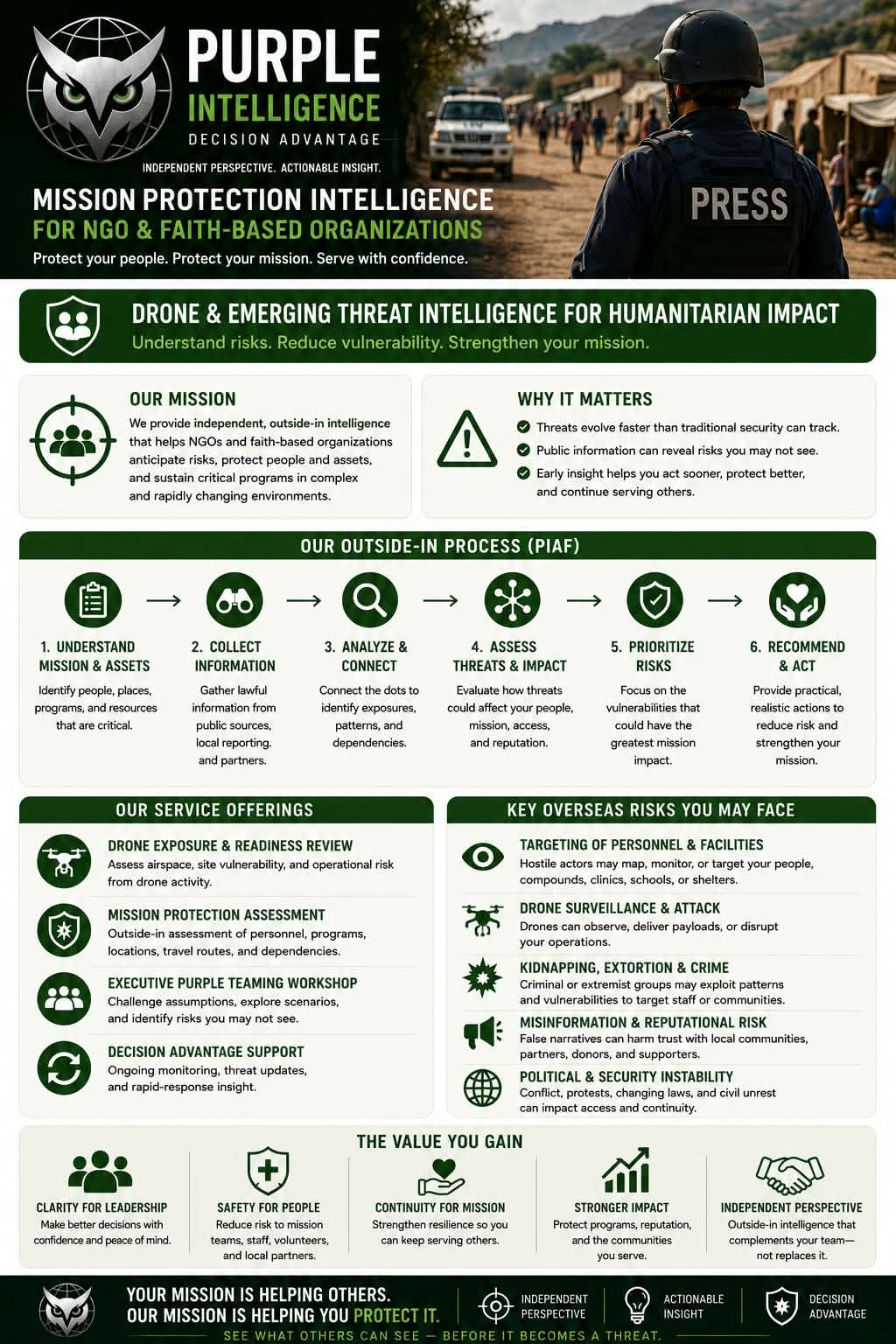
NGO & Faith-Based Organizations
Mission Protection Intelligence
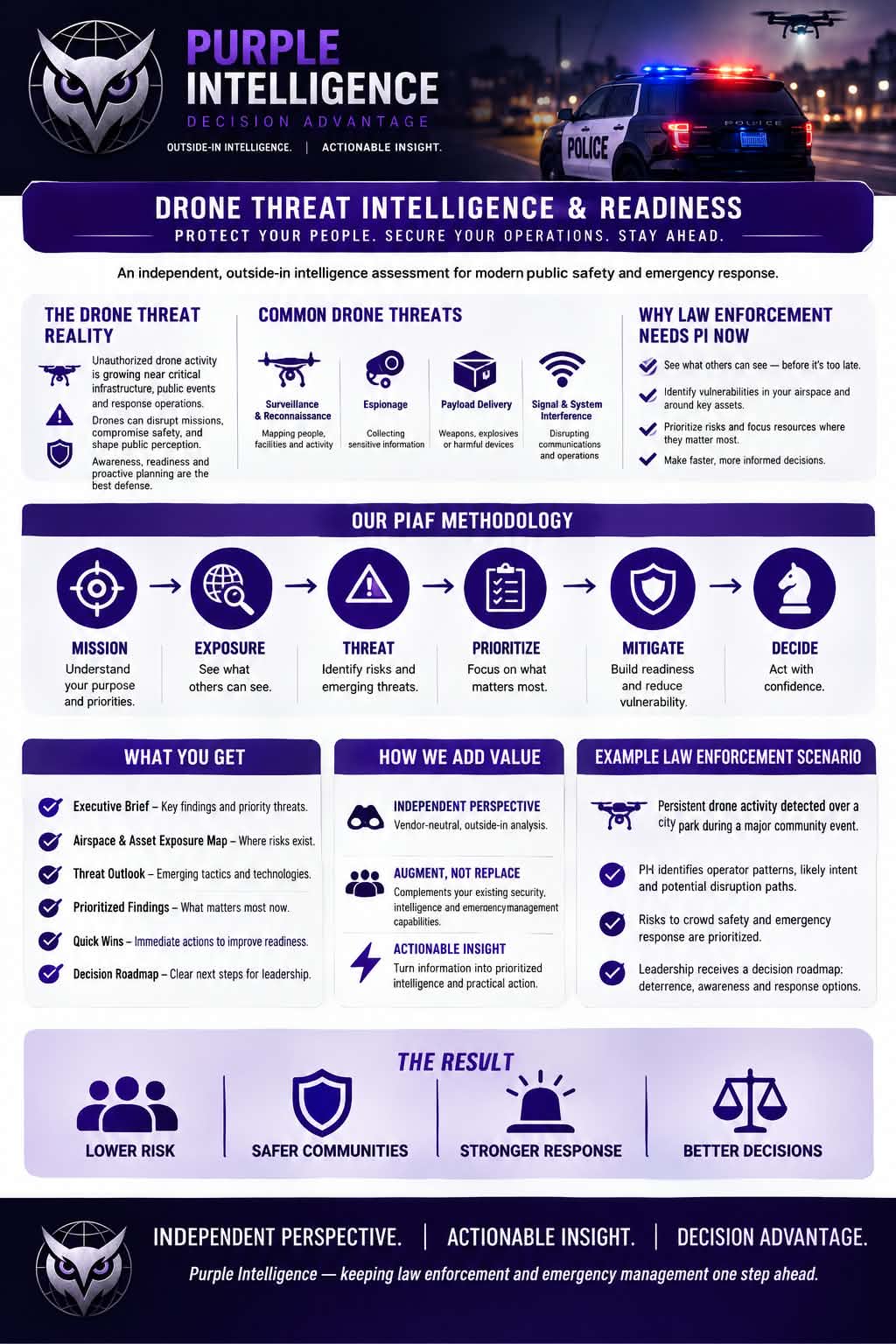
Law Enforcement & Emergency Management
Drone Threat Intelligence & Readiness
How we operate
We complement your existing functions—never replace them.
Lawful sources only
Work uses lawful public and customer-authorized information.
Disciplined analysis
We separate fact, judgment, assumption, and scenario.
Stated confidence
We record confidence and limitations for every finding.
We augment, not replace
We support existing security, risk, and law-enforcement functions—we do not replace tactical responders.